
Québec Residential Construction: Housing Starts, Completions and Real Investment
The study and downloadable documents are in English. A French summary is available through the language switch.
Québec housing starts rebounded in 2025, while real residential investment remained below 2021. A descriptive study of activity, composition and data coverage.
Read, present and reproduce the study
The economic note provides the interpretation; the presentation expands the analysis, and the workbook, data and source package document the calculations.
- Economic Note PDF · English documents
- Sector-analysis presentation PDF · English documents
- Editable presentation PPTX · English documents
- Research workbook and calculations XLSX · English documents
- Annual dataset CSV · English documents
- Source register CSV · English documents
- Full study, data, sources and reproduction files ZIP · English documents
A strong recovery, with a different construction mix
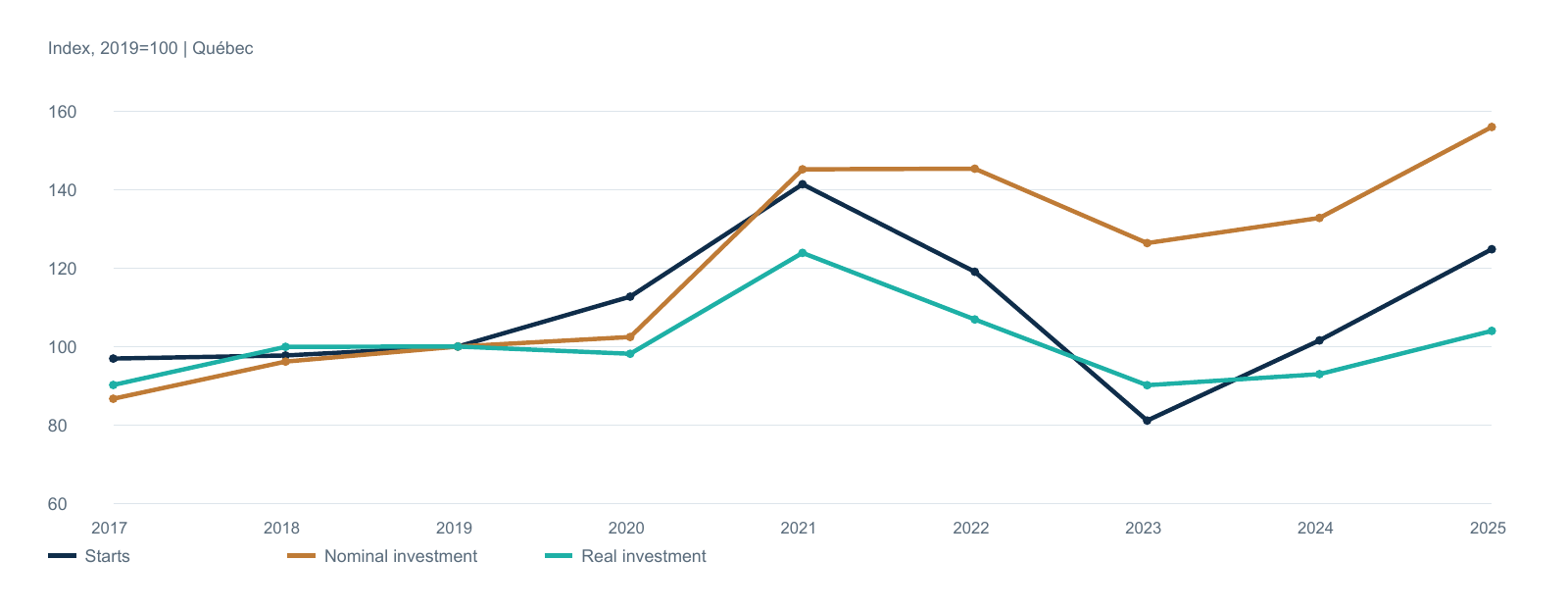
Québec recorded 59,864 housing starts in 2025, up 22.9% from 2024 and 53.8% from the 2023 trough. The rebound is substantial, but starts remained 11.7% below the 2021 peak of 67,810. Real residential building investment reached $37.20 billion in 2023 dollars, up 11.9% in 2025, yet 16.0% below its 2021 peak. More projects are entering the pipeline, while the volume of work put in place has recovered more slowly. [S1–S3]
The contrast is sharper over a pre-pandemic baseline. Between 2019 and 2025, starts increased 24.8%, nominal investment increased 56.0%, and real investment increased only 4.0%. Dollar spending therefore substantially overstates the increase in construction volume. Constant-dollar investment measures price-adjusted work, rather than a count of new homes. [S1, S3]
Source: Statistics Canada / CMHC; calculations: The Macromist. Research vintage: 30 October 2026.
The recovery is concentrated in apartments
Apartments and other unit types accounted for 47,671 starts in 2025, or 79.6% of Québec's total, compared with 64.2% in 2015. This category contributed 10,357 of the 11,151 additional starts in 2025: 92.9% of the annual increase. Single-detached starts slipped 0.9% to 8,477 and were 20.9% below 2017. The improvement in the aggregate does not describe an equally strong recovery across suppliers or building types. [S1]
CMHC's metropolitan evidence supports a tenure distinction as well: rental housing represented over 80% of Montréal's 2025 starts. That result applies to Montréal, not to all Québec apartments. Apartments can be rental, condominium or other tenure; a dwelling-type split cannot establish the provincial rental share. [S8]
Source: Statistics Canada / CMHC; calculations: The Macromist. Research vintage: 30 October 2026.
Nominal growth conceals a smaller volume recovery
Nominal investment was almost unchanged in 2022 (+0.1%), even as real investment fell 13.7%. A further 15.7% real decline followed in 2023. Real activity subsequently grew 3.1% in 2024 and 11.9% in 2025. By 2025, nominal spending was 7.4% above 2021, while the constant-dollar measure was still 16.0% lower. These are different economic signals, not conflicting estimates. [S3]
The ratio of annual nominal to constant-dollar investment rose 28.0% between 2021 and 2025. This is an implicit annual price ratio for the measured investment basket, not a home-sale price index or an estimate of a builder's costs or margins. Statistics Canada's constant-dollar series already incorporates construction-price deflation; applying consumer-price inflation would introduce a different, inappropriate price concept. [S3–S4]
Work on existing buildings is a major part of investment
In 2025, measured residential investment totalled $39.77 billion at current prices. Of this, $18.27 billion was classified as new construction (45.9%), $19.07 billion as renovations (47.9%), $0.90 billion as conversions and $0.44 billion as other work. A further $1.09 billion is the residual, principally minor projects not allocated to those work categories. Omitting that residual would prevent reconciliation with the published total. [S3]
The multiple-dwelling investment component supplied 74.5% of the 2025 increase in real residential investment. It reached $21.05 billion in 2023 dollars, compared with $16.15 billion for single-dwelling buildings. These investment categories have broader coverage than CMHC's single-detached and apartment counts: they include work on existing buildings and additional structure categories. [S3]
Starts and completions describe different moments
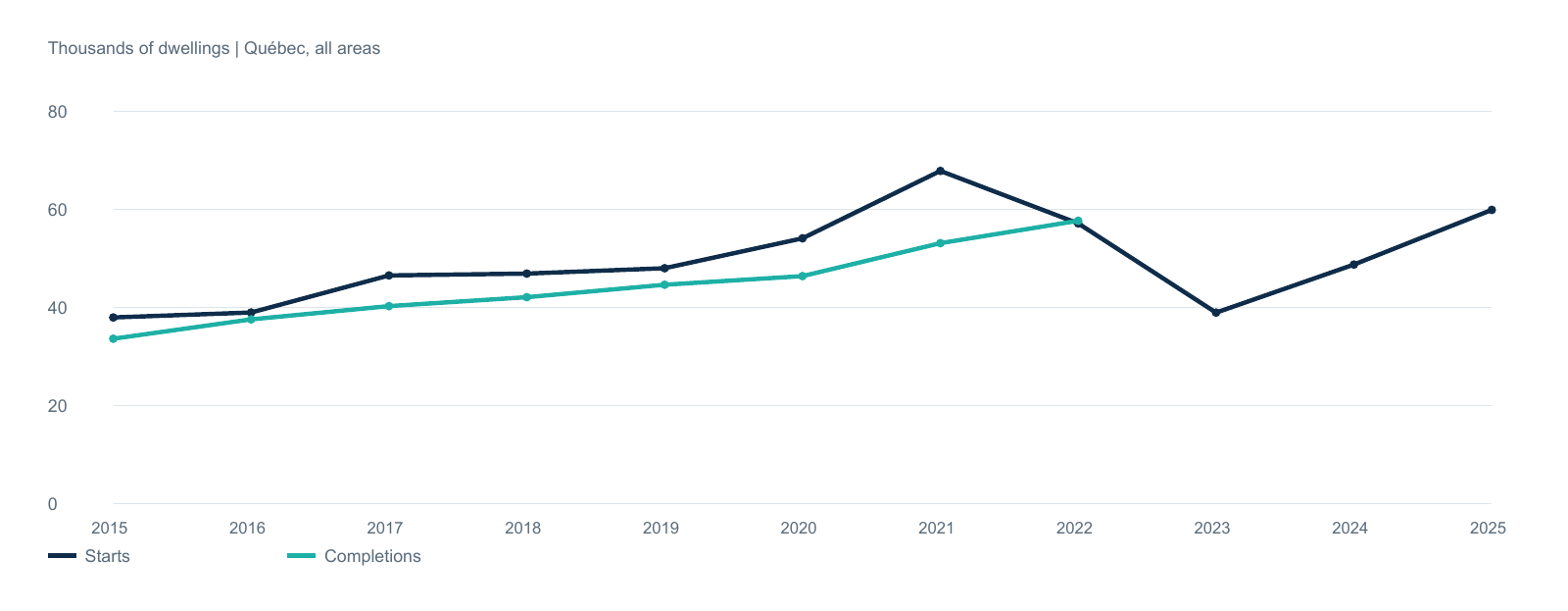
Starts count units when construction begins; completions count units reaching completion, often from earlier cohorts. In the comparable all-area series, starts rose to 67,810 in 2021 while completions reached 53,078. In 2022, starts declined to 57,107 but completions rose to 57,649. This is consistent with earlier projects moving through construction, though the annual totals alone cannot estimate construction durations. Starts minus completions is not an exact inventory identity because adjustments and other movements can intervene. [S1–S2]
There is no defensible uninterrupted all-area completions comparison through 2025 in these tables. Provincial all-area completions end in 2022. Survey coverage narrowed in 2023, and urban coverage of 10,000+ was reintroduced from Q3 2025. An official federal briefing reports 51,389 Québec completions in 2025 under changing surveyed coverage. We report that figure separately and calculate no growth against earlier all-area totals. Missing observations remain missing. [S5–S7]
Economic interpretation and scope
For construction associations and suppliers, the evidence points to a recovery concentrated in multiple-unit activity and a sizeable renovation market. Unit counts, the value of work and the timing of delivery should be monitored together. More starts need not generate proportionate same-year work: projects differ in size, type and construction schedule, and the investment basket includes existing buildings. Moreover, the indicators are not fully independent: Statistics Canada's residential investment estimation uses CMHC starts information. [S1, S3–S4]
The financing backdrop changed materially: the Bank of Canada's overnight target reached 5% in July 2023 and was 2.25% by October 2025. These dates help frame the cycle but do not identify what caused the rebound. COVID also affected measurement: CMHC did not conduct its April 2020 survey in Québec. This study uses the current annual observations and does not impute that month. It estimates neither policy effects nor profitability and makes no forecast. [S9–S10]
Methods
Study vintage: 30 October 2026. Starts and investment: 2017–2025; housing-count background: 2015–2016; all-three comparable window: 2017–2022. Investment begins in 2017 in successor table 34-10-0293-01. Sum 12 unadjusted monthly dollar flows; use published unadjusted annual unit counts and cross-check against four quarterly flows. Never sum SAARs or under-construction stocks. Use official constant 2023 dollars. January–February 2017 constant values retain a mixed-base caution, so the principal indexed chart uses 2019=100. Do not splice archived price bases. All 11 starts totals and eight completions totals reconcile exactly with quarterly observations. Two chart series are independently reconstructed from original source rows; the audit files record endpoint observations, vectors and differences. Values are subject to revision, not final estimates. This is a descriptive sector study, not a causal model.
Sources
- S1 Statistics Canada / CMHC: Housing starts, under construction and completions, all areas, annual (34-10-0126-01). Accessed 2026-10-30.
- S2 Statistics Canada / CMHC: Housing starts, under construction and completions, all areas, quarterly (34-10-0135-01). Accessed 2026-10-30.
- S3 Statistics Canada: Investment in Building Construction (34-10-0293-01; survey 5014). Accessed 2026-10-30.
- S4 Statistics Canada: Investment release and methodology (Daily 2026-10-21; survey 5014). Accessed 2026-10-30.
- S5 CMHC: Detailed table catalogue and definitions (Monthly Housing Starts and Other Construction Data Tables). Accessed 2026-10-30.
- S6 CMHC / Parliamentary Budget Officer: Completions coverage changes (Modernizing Housing Data; PBO BLOG-2425-008). Accessed 2026-10-30.
- S7 Housing, Infrastructure and Communities Canada / CMHC: 2025 housing completions by province and dwelling type (Key Issues, June 2026). Accessed 2026-10-30.
- S8 CMHC: 2025 release and Montréal context (Housing Starts, December 2025). Accessed 2026-10-30.
- S9 CMHC: April 2020 survey interruption (2020-05-08 release). Accessed 2026-10-30.
- S10 Bank of Canada: Financing backdrop (Policy rate decisions). Accessed 2026-10-30.